

What Is Hybrid Training? (And Why You’re Doing It Wrong).
What The Hell Is Hybrid Training?
Surprisingly, hybrid training isn’t another fitness fad.
It’s not a class, a cult or something that requires yet another subscription.
It’s simply training for more than one fitness goal at the same time.
Usually goals that don’t naturally help each other.
So if you’re trying to get stronger and build muscle, that’s not really hybrid training.
Those two complement each other.
(And let’s be honest…have you ever seen a skinny powerlifter?)
But trying to build muscle while training for a marathon?
That’s hybrid training.
The two goals pull the body in different directions and require different types of adaptation.
One is asking your body to become more efficient and durable.
The other is asking it to become bigger and stronger.
That’s where things get interesting.
You’re Probably Hybrid And Didn’t Even Know It
If you do combat sports and lift weights…
You’re hybrid training.
Hyrox?
Hybrid training.
CrossFit?
Hybrid training.
Triathlon?
Definitely hybrid training.
Even if you just lift weights to maintain muscle and bone density while doing cardio so you don’t keel over at 55…
That still counts.
Most people are already doing some form of hybrid training.
They just haven’t labelled it yet.
What’s The Problem With Hybrid Training?
Every workout you do is a message to the body telling it what you want to improve at.
If you lift a relatively heavy weight for a 5 rep max you set of a series of signals to the cells telling them how they need to adapt.
If you run 5 miles you set of another chain of cell signals that now tell the body to become better at utilising oxygen etc.
If you do both of those things in the same training session the body wonders what the hell you’re trying to do.
This is the interference effect.
The theory suggests that the adaptation to one goal interferes with the body's ability to adapt to the other goal.
Managing Your Energy Levels
You have a finite amount of energy to spend each week.
If your one goal is the smash your neighbour at Park Run, you can focus that available energy on running.
But if you want to smash them at running and make them feel puny when they see your holiday photos you have to split your available energy.
A HUGE problem is that many people will try to do 100% on their 5km run training and 100% effort on increasing their stud rating.
Throw in a bit of real life (work deadlines, sick kid keeping you up all night etc)...
You don’t need to be a maths genius to know that doesn’t add up.
It’s why so many people get over knackered, burn out and never get near achieving their goals.
Hybrid Myths
“But bro, cardio kills your gains”.
I”ve heard this so many times…and it’s always from gym bro’s /body builders.
They’ll take a meme like this one.
The sprinter lifts weights and focus’s on power training.
The marathon runner just runs miles.
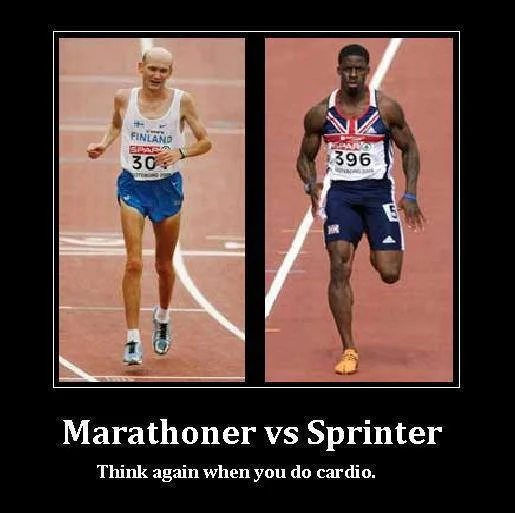
A common myth that cardio destroys muscle
Of course these two look different, their training is completely different.
(As well as their genes and probably whatever else they take to “assist” them).
The marathon runner is focused on running very far as fast as he can, he doesn’t give a monkeys about being jacked.
Big ol’ biceps and pecs are just more weight that he will need to carry and provide energy to.
A gym bro will tell you that running will increase the stress hormone cortisol that will destroy your muscle.
Mate, if you don’t have cortisol you’re dead.
It’s what wakes you up in the morning.
It rises with any type of exercise.
And consider this.
Have you ever seen a heavyweight boxer?
Those massive, muscular powerhouses are absolute cardio machines.
Cardio itself does not kill your gains.
(If you’re struggling with progress then you may find this article useful “Why You’re Not Seeing Results”)
Don’t Be Like Me
In my early gym days I had two fitness goals.
Get a 5km PB and have a bigger bench press than my flat mate.
One week I’d just lift, and give it the big ‘un on Saturday when training with my mate.
Then feel like a lumbering wheezing blob when I ran for a bus.
So the following week, hit the treadmill 2-3 times (obviously trying to go fast as possible each time), then feel puny instead of smashing flat mate.
You HAVE to have a plan that makes sense.
A plan that takes into account the different abilities needed to hit your goals.
As well as the energy and recovery available to you.
MED vs MRV
Stand by for some complicated names that describe something simple to understand and yet often overlooked in training.
(The older you get the more important this next bit becomes).
MED stands for Minimum Effective Dose.
What is the minimum amount of work you can do that will elicit the training response you want?
MRV stands for Maximum Recoverable Volume.
This means, how much work (training) can you do over a period and still be able to recover back to your baseline in a couple of days.
Rather than driving yourself into a big hole where everything feels like crap.
Why does this matter?
Because most of us (myself included) have a tendency to be a plum.
If I haven’t ran for a while I’ll get out with the plan of a steady heart rate, keep it low effort.
But I feel fresh (of course I do, I haven’t ran in weeks and I’m full of carbs), so the pace goes up a bit.
Suddenly it’s full send, trying to race and getting home in a mess.
I’ve just caned a lot of energy and increased the amount of time I’ll need to recover.
So instead of feeling fresh tomorrow after a low intensity run, I’m starting feeling fatigued, can’t lift as much and driving myself further into a crap pit.
When you’re starting your hybrid journey you need to be closer to the MED in your training sessions.
And only at planned points in your program start approaching MRC…when you’ll have planned in extra recovery time.
The Real Problem With Hybrid
Picture being back at school and it’s exam time (hold the PTSD).
If you have just one subject to study for it will probably take you less time to prepare than if you have two subjects.
If you only have one subject to consider you may also be able to achieve a deeper understanding of the subject.
It’s a clumsy analogy but it’s the same thing with hybrid training.
You can get very good in two competing physical attributes, but it’s going to take longer than if you were only chasing one.
You will unlikely excel as much either than if you focus on just one attribute.
We’ve seen the Olympic 100m and 200m won by the same person as they’re very similar events.
You will NEVER see the 100m sprint champion rocking up and winning the marathon or vice versa.
The Good Thing About Hybrid Training
Personally, I think it’s fun and in all honesty I get to feed the two sides of my ego.
I’ve focused on just lifting weights and it’s kind of nice when you notice your tshirt getting tighter (in a good way).
But I hated playing football with my little nephew and feeling out of breath in two minutes.
I’ve focused on just marathon training and loved feeling fast and taking ages to fatigue.
But I hated my old flat mate being able to call me skinny.
I’m never going to be a top athlete.
I just want to feel good in a variety of situations.
Lid stuck on the jar? I’ll sort that love.
Here, let me carry your suitcase up the stairs.
And still be able to stand on the start line of a race and feel the nerves and excitement…before the sense of achievement at the end.
Top Tips For Planning Your Hybrid Training
Every performance goal you have will have different demands.
A 5km runner will need to develop speed over shorter intervals as well as lower intensity/longer duration cardio.
A BJJ competitor will need technique developed at slow speeds before they can go hard and fast.
During your week it makes sense to group similar demands together.
For someone trying to build muscle and running endurance it could pay to have your shorter, intense intervals towards the start of the week.
Along with lifting sessions that involve lifting at lower rep ranges with heavier weights.
Tempo running work in the middle.
Whilst your lifting moves more towards mid intensity, hypertrophy style training (traditionally 8-12 rep ranges).
Then lower intensity, longer duration steady pace runs towards the end of the week.
In this way the signals you send your body as to what you want it to adapt to will be similar.
Ideally what we want to do is avoid training completely competing demands in close succession.
Such as low rep deadlifting Monday morning, then a 10 mile run on Monday evening.
Putting It Simply
One of the best things about hybrid training is the variety.
After all, who doesn’t want to be decent at more than one thing?
Being strong is useful.
Being fit is useful.
Being able to do both without feeling like your body is held together with blu tack and resentment is probably the sweet spot for most people.
But here’s where people go wrong.
They’ll find a running programme online and try to combine it with the “Get Absolutely Jacked” gym programme they bought two years ago.
Then wonder why they constantly feel battered, exhausted and make absolutely no progress in either.
You can’t really wing hybrid training.
Well…you can for a while.
When you’re new to training your body adapts to almost anything.
But as you get fitter and stronger, your training has to become a bit more structured.
A bit more intelligent.
You need to think about:
what you’re training,
when you’re training it,
and whether you can actually recover from it.
Because recovery is part of the programme.
That means:
decent sleep,
enough food,
enough water,
eating something green occasionally,
and maybe spending slightly less time doom scrolling at midnight.
Hybrid training absolutely works.
You just need balance, structure and realistic expectations.
And finally…
If a gym bro tells you cardio kills your gains…
Tell them to jog on.