Why You’re Not Seeing Results in the Gym
The direct debit is going out every month but those gym gains don’t seem to be showing up.
Another month has passed by, another direct debit for the gym has gone from your account…but the results…
…the reason the alarm tears you extra early from sweet sleep…
…the reason your work bag is 50% heavier as you lug your training kit around…
…those results…well they aren’t what you hoped for.
It feels like there’s plenty of effort going in.
So what’s actually going wrong?
First — Are You Actually Training Consistently?
It’s Easy to Overestimate How Often You Train
Don’t take this the wrong way, but are you actually training as often as you think you are?
(We have to rule out the obvious before we go any deeper).
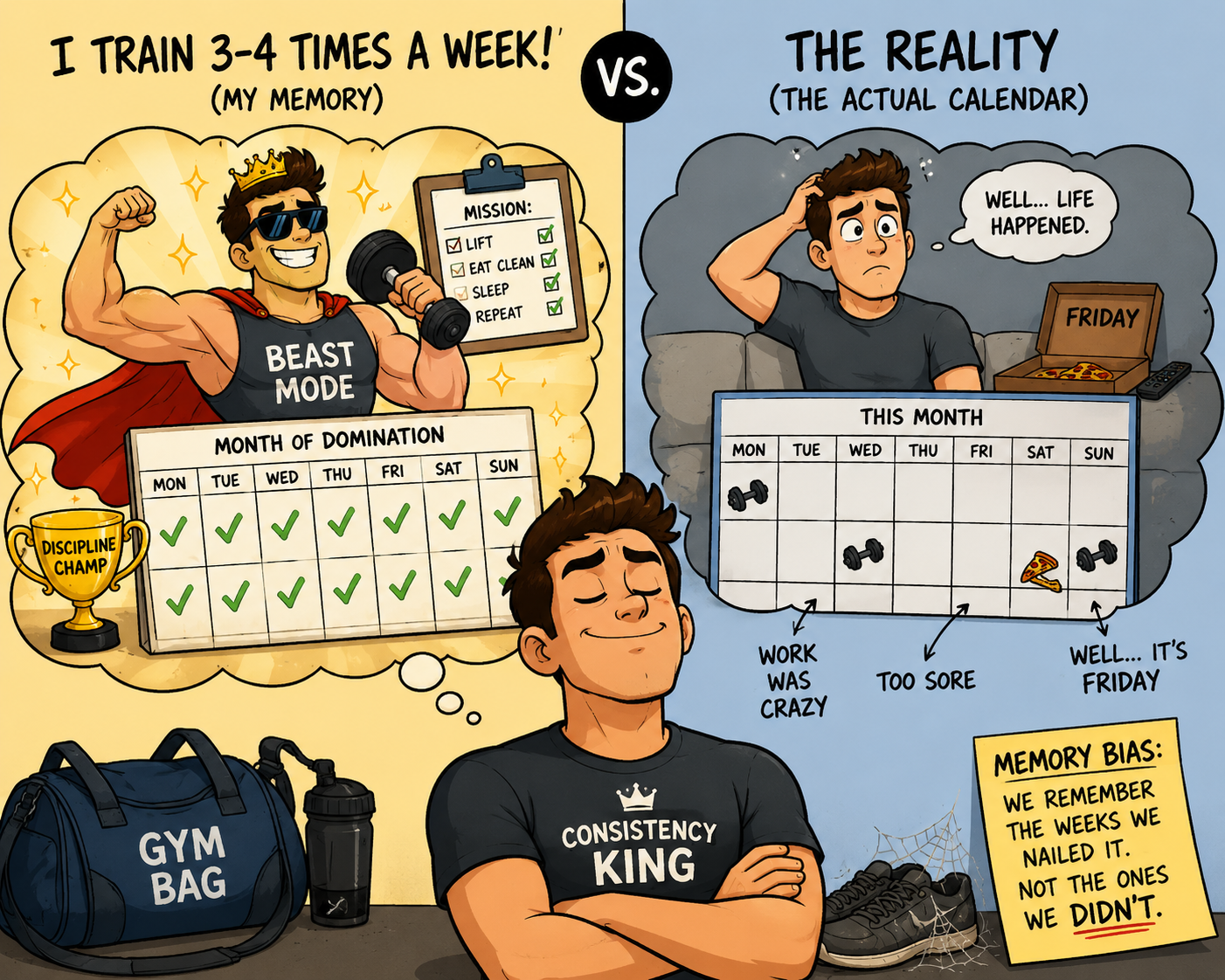
Over the years I’ve seen countless people swear they’re training 3-4 times a week, because that was their honest intention.
And some weeks they do…and those are the weeks they remember.
What skips their mind is the week work kicked off and there was no time to go.
Or the week they overdid it on Monday, were unbelievably sore on Wednesday (so couldn’t felt it smarter to rest), the Friday was…well Friday…might as well get going again on Monday>
We all have memory bias that puts focus on what we have done and lets our little inconsistencies slip under the radar.
Look back over the last month without rose tinted glasses and assess if you have been consistent enough.
What’s the Minimum That Actually Works?
If you’re an absolute beginner you’ll get some joy from two sessions per week.
After that early phase though, twice a week is good for maintaining what you have rather than progressing.
Three times a week, you’re getting into the gains business.
Four times a week though…that one extra session…often adds rocket fuel to your results.
This was something I learned at a seminar with the late Charles Poliquin (coach to multiple Olympic gold medalists and champion bodybuilders), and I can’t think of a time when this proved to be wrong.
When you’re new to training, your body will respond super well.
But as you advance you’ll find your body needs more of a stimulus to progress.
What Do You Actually Mean by ‘Results’?
Before we crack on, we need to make sure we’re talking about the same problem.
What do you mean by “results”?
What is the change that you’re looking for?
Fat Loss vs Strength vs Fitness
Let’s take a quick peep at the three main outcomes most gym members are looking for and see which one matches your goals.
Fat loss - reducing the amount of your body fat you currently have. This is usually measured as a percentage of your total body composition.
Strength - being able to move and lift heavier weights.
Fitness - a very general term, but we’ll use it for now to cover being able to do more “work” in a given time. So able to run a set distance faster, go further in a set time, or perform more sets/reps in a given time.
Progress in these different goals will present in different ways.
It may be that you’re stalling in one area whilst progressing in another and not realising it.
The Gym Creates the Stimulus — Not the Result
When you lift weights, smash yourself on a rowing machine or try a pullup all you’re doing is sending a stimulus to your body.
It’s a signal that you want to get better at a certain skill, and hopefully, you’re body responds by improving how well your muscles, heart, energy delivery systems work.
These improvements don’t happen instantly.
If anything initially they make you a bit worse…you don’t run a personal best 5km or squat a new personal best and instantly be faster and stronger.
Those improvements came from your previous training sessions.
Adaptation occurs outside of the gym and is very dependent on how well you recover.
This means food quality, sleep quality and adequate hydration.
If you miss this side of the equation all you’re doing is breaking yourself down and not supplying the required ingredients to rebuild as harder, better, faster, stronger (as Daft Punk would say).
If You Want to Get Leaner, Nutrition Is Key
Just hitting the gym doesn’t entitle you to dropping any excess wobbly bits.
The brutal truth is that in your gym circuit class you’re likely burning 200-450 calories.
Let’s be mean and say you had an easier session and it’s closer to 200 calories.
That’s four Oreos.
You’re possibly now thinking “what’s the point in going?”
That training session will:
Add to your daily calorie deficit to make weightloss a little easier.
It will help ensure that your body is more likely to use the food you eat for fuel rather than adding to wobbly bits.
It will improve how well your body responds to hormones such as insulin and help keep the risk of type 2 diabetes and other cardiovascular risks (that will seriously mess with your quality of life), at bay.
Beware of feeling that you have earned more food or deserve a treat because you have exercised.
Have treats etc in your life but if you want to lose bodyfat be aware that rewards for exercise are often contain more calories than your training consumed.
Are You Tracking Progress - Or Just Turning Up?
How do you know that progress is or isn’t happening…what are you tracking?
I mean…you are keeping track of what you’re doing…aren’t you?
When you don’t track there’s two potential scenarios working against you.
First - If you have kids or young kids in your family you’ll know the feeling of looking at them one day and being blown away by how much they’ve grown.
It’s like they’ve just sprung up in one instant…but they obviously haven’t.
They’ve been growing all the time in front of you, you just don’t notice the small incremental changes.
You, mon ami, are the same.
Changes are happening and if you don’t pay attention you don’t realise it’s happening.
Second - your memory sucks.
I know you think you’ll remember what weights you lifted and how many reps you did…but you won’t.
In your next training session, you’ll be guessing, lifting each dumbbell like you’re testing the weight of your holiday suitcase.
Write down what you’re doing - a notebook, an app…use a papyrus and quill for all I care (they’ll probably be back in fashion soon…”omg soooo retro”).
Just record your session.
(My clients have their programs in my training app and just need to plug in the weight and reps they hit).
Performance Is the First Sign of Progress
After each week look back and see if you lifted a tiny bit more weight for the same reps you hit the previous week?
Or did you keep the same weight but hit more reps with it?
Did you do the same weight and reps but it felt smoother and you were less knackered afterwards?
Before anyone looks at you and says “wow, have you been working out honey?” you will notice an improvement in your performance.
So instead of rushing to the bathroom mirror and checking for abs like a kid at Christmas checking if Santa has been, look at the tangibles.
If Performance Is Improving…But You Look the Same
If you are getting stronger, faster…your gym engine is powering up.
But you’re looking the same.
And this is proved by your tracking, the tape measurements, scales, how your clothes fit etc…
…then, the problem isn’t the gym, it’s likely to be your nutrition.
The gym is doing its job, you can see that in your performance.
If You’re Not Progressing — Here’s Why
What if your training is going in circles…what to do then?
1. Your Training Isn’t Structured
Deciding what you’re going to train as you walk onto the gym floor.
Asking Dave in accounts what he’s training and tagging on.
Seeing what you “feel like”.
Are all fantastic ways to not get very far.
Training involves repetition.
Not just in a set, but week on week.
When you perform an exercise, your body learns the movement.
As the movement becomes more familiar your nervous system lets you start to lift more weight.
As the movement becomes more familiar the level of soreness you feel decreases.
Gym adverts sell you good looking people, in beautiful gym kit, with perfect hair, looking amazing and then high fiving each other.
Real gym results come to people who’d rather be at home with Netflix, hating the fact they have another set of split squats to hit, and doing it regardless of what they “feel like”.
Hopefully. Most of the time you enjoy training, but you need structure and repetition to improve, and you won’t always feel like it.
2. You’re Not Training Hard Enough
There’s no badges for just turning up at the gym.
It’s a bloody good first step.
But remember, you have to give the body a reason to adapt.
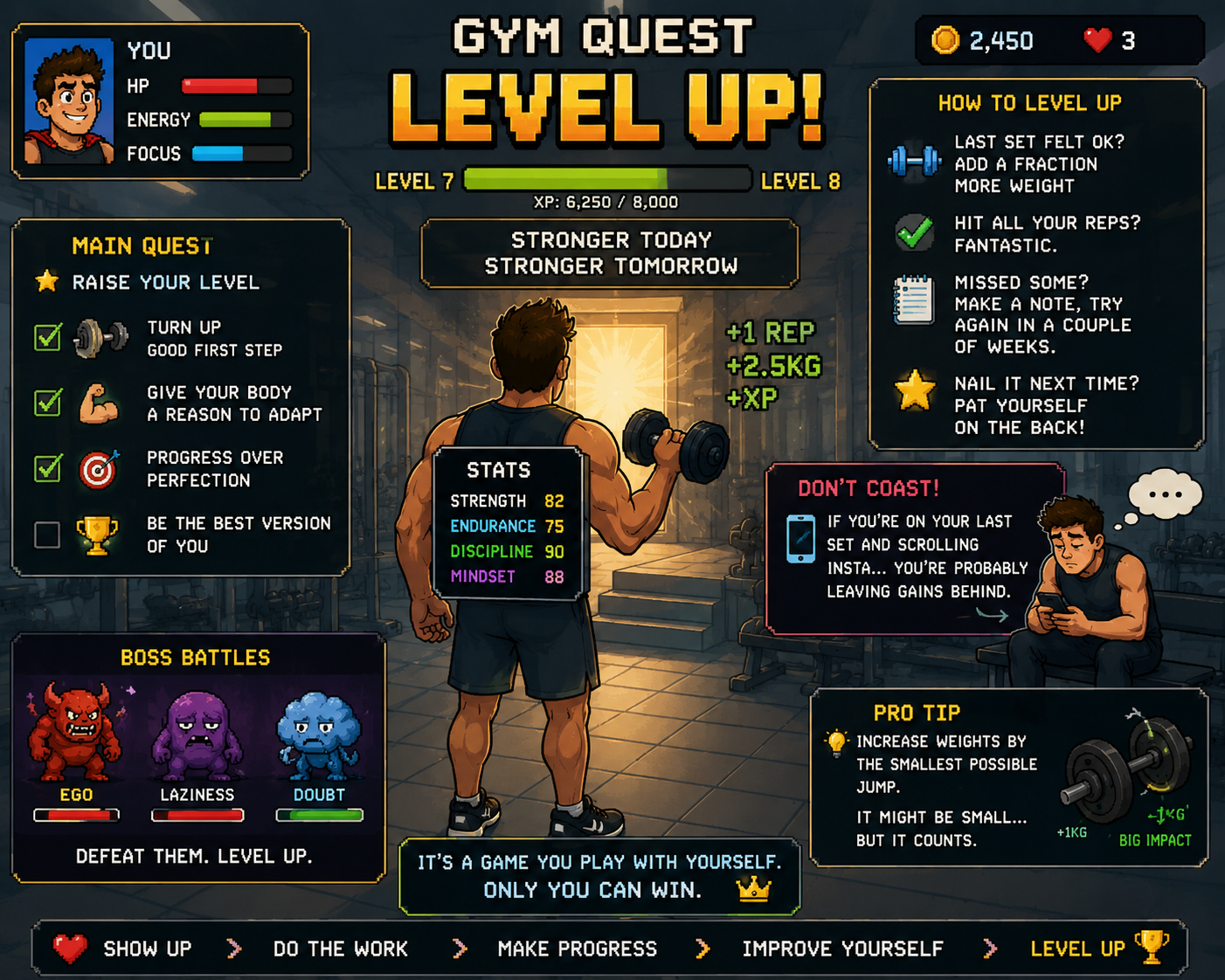
The gym is just a game you play with yourself.
And the goal is to raise your level.
If your last set felt ok then try just a fraction more weight.
If you hit all your reps…fantastic.
If you don’t…make a note and in a couple of weeks try again and give yourself a pat on the back when you nail it.
No one is saying you should smash yourself every session…and you should always ensure you don’t lose technique in order to get an extra rep.
But if you’re on your last set and scrolling through Instagram, forgetting about time, rather than slightly dreading the last set and gearing yourself up for it…
…the chances are you’re coasting a bit.
Moving up a set of dumbbells or adding a fraction more to a bar can look intimidating.
But remember…it’s a game that only you can win.
Only increase your weights by the smallest possible jump (you’ll be surprised how much more challenging that can feel).
But don’t be afraid to impress yourself.
3. You’re Not Doing the Right Exercises
I started going to the gym in the dark ages before the internet. I remember looking at the weights and not having a clue what to do with them.
I asked the most muscular guy at work what to do…he didn’t have a clue either (just blessed with lucky genes).
So, I hit some arm curls…because that was the only exercise I knew from TV.
An overlooked fact is that training is a skill.
It’s not a case of “I pick things up and put them down’ (say this in your best Arnie accent).
The exercises that will bring you the greatest success take a bit of learning (and they’re not arm curls).
Compound exercises use a lot of large muscles and use a number of muscles together.
For example, a deadlift, will use your thighs, butt, abs and forearms.
The bigger the muscle, the more energy is required to train it.
The greater the number of muscles recruited, the greater the energy required.
I was on road to nowhere with my poorly executed arm curls that only used my titchy biceps.
To get results, try and prioritise compound exercises such as presses, rows, squats and deadlift variations.
4. You’re Being Too Impatient
Are you just having a lack of patience?
As Freddie Mercury may have said “I want it all and I want it now”.
However, it doesn’t work like that treasure.
Building strength is like rolling a snowball.
To begin with, the results may feel a little slow.
As you become stronger, you can lift more weight or train a bit longer.
Which gives the body a greater stimulus to adapt to.
In an age when we’re used to getting everything now (seriously my dad moaned when chatgpt took over 20 seconds to generate an image from some words…wtf?).
Progress and results involve sticking at the task, week in, week out and putting in the effort.
If you want to know more about how to train without picking up injuries or burning out, you’ll find my other article useful, “How to Get Fit in Your 40s (Without Burning Out or Breaking Down)”.
Why the Scale Might Be Lying to You
The scales aren’t ideal as the only way to judge progress…but it’s what many of us look at, so this is important to keep in mind.
Daily Fluctuations Are Normal
The scale isn’t going to dive down day in day out.
Some days it will go up.
The reasons why are varied but the most common are.
Salt - if you’ve eaten a salty meal the night before then your body will be primed to retain more fluid.
Sleep - poor quality sleep or a general lack of it makes losing weight a lot harder. If you’ve had a crappy night, don’t be surprised if the scale reflects that.
Training - weight is likely to bounce up in the days after training as the body repairs and strengthens itself.
Focus on Trends, Not Daily Numbers
Don’t stress too much about the day to day fluctuations.
This goes for your gym performance and the scales.
Look at what is happening over the course of weeks, this will show you if you’re heading in the right direction.
Sit tight with your plan, give it time to be effective and then make decisions based on the results.
What To Do If You’re Not Seeing Results
1. Train Consistently (2–4x per week)
Make sure your body has a reason to adapt.
2. Follow a Structured Plan
Have a plan…but also have a plan for when the week is less than perfect. With my clients we have “sawn off” versions (the minimum they need to do in the gym) or sessions that can be performed at home with minimal kit.
4. Dial in Your Nutrition (if fat loss is goal)
What you do outside of the gym iis where you’ll really win.
5. Be Patient — Give It Time
You can’t just download your next physique.
Final Thought: Results Come From Direction, Not Just Effort
Making positive changes to your life is rarely easy and often bloody hard.
Especially when you’re not seeing the outcome you’re making all the sacrifice for.
It’s easy to assume that either there’s something wrong with you…(after all, your socials feed is full of people smashing it and looking like their life is in perfect order).
Breaking news…there’s nothing wrong with you…there’s probably just some small modifications needed or a little more patience.
The key isn’t to be perfect all the time, but you do need to turn up, challenge yourself a little, pay attention to what you do and have patience.
If you feel like you’re putting the work in but not seeing the results, you’re probably missing a key piece.
That’s exactly what I break down every week in Your Missing Link…my fast growing weekly newsletter that gives you the skills and the knowledge to move better, be stronger and feel great for years to come.
If you’re ready for free weekly progress click this link.