Why Weak Muscles Stay Weak
Have you ever been told you have weak glutes or tight hips?
It’s a diagnosis that gets handed out the way Oprah used to hand out cars.

My glutes were apparently really weak.
I knew this because every physio I saw blamed them for the knee pain that kept wrecking my running.
A real highlight was the Aussie physio who looked at my hips and said:
“Are you fuckin’ kiddin’ me mate?”
Which, medically speaking, probably wasn’t ideal.
So I did what everyone does.
I foam rolled.
Stretched.
Did ALL the clamshells.
Monster walks.
Lunges.
And honestly?
Some of it helped in the short term.
But long term, nothing really changed.
My glutes still didn’t feel strong.
My hips still felt tight.
And my body still moved like the Tin Man after a long-haul flight.
It took me years — and a lot of courses — to understand why.
The problem wasn’t that I wasn’t trying hard enough.
The problem was that I was looking at muscles in isolation instead of looking at the position of the joints those muscles attached to.
Because muscles can’t work properly if the joints around them aren’t giving them the space or leverage to do their job.
And once you understand that, a lot of frustrating things suddenly start making sense.
The Problem With The “Weak/Tight Muscle” Model
Have you ever been unfairly blamed for something?
Completely stitched up by a sibling or a colleague?
It’s worse when you’re the one working hardest to make things ok, and then everyone else starts pointing fingers at you when it was Steve in accounts who dropped the ball.
This is life for some of our muscles.
They’re just trying to do their job, move us around…the last thing on their mind is to be causing grief.
But when your hips stop performing well its them that gets the blame.
Those damn hip flexors getting tight.
Bloomin’ hamstrings getting tight.
But why would this happen…they haven’t been plotting.
The real problem is that we’ve got things back to front.
What if the actual joints are out of position and the muscles are trying to make the best of an awkward situation?
Let’s take the hamstrings (the big chunky muscles on the back of the thigh).
It’s amazingly common how often the pelvis changes position relative to the other bones.
Most commonly it will tip forward.
The hamstrings attach to the underside of the pelvis.
As it tips this lengthens the hamstrings.
You sense this as the hamstrings becoming “tight”....but we interpret this as they have become “tight” as in shortened, but they’re tight as in overlong.
Like a guitar string that has been over wound.
Because you feel tight, your instinct is to stretch them…but they’re already long and stretching just feeds into the issue.
A Muscle Needs Access To Movement
To be strong, a muscle needs to be able to lengthen and shorten.
The simplest example of this is a biceps curl.
You let your arm extend, which lengthens the bicep, then you bend your elbow to squeeze the muscle and shorten it.
If you only ever bend your arm halfway then there is a large part of the movement that the muscle doesn’t get trained in…and therefore will stay weak in that range.
Taking this a step further, if a joint is out of alignment with the surrounding joints, this will pull the muscles out of position and they’ll no longer have access to their full range.
Getting The Stack
One of the simplest ways to improve movement throughout your whole body is “the stack”.
This isn’t the pancake option at the local cafe (sorry to get any hopes up).
It just means having your ribcage stacked over your pelvis.
This provides our best alignment for moving well.
Here’s a super simplified image to explain.
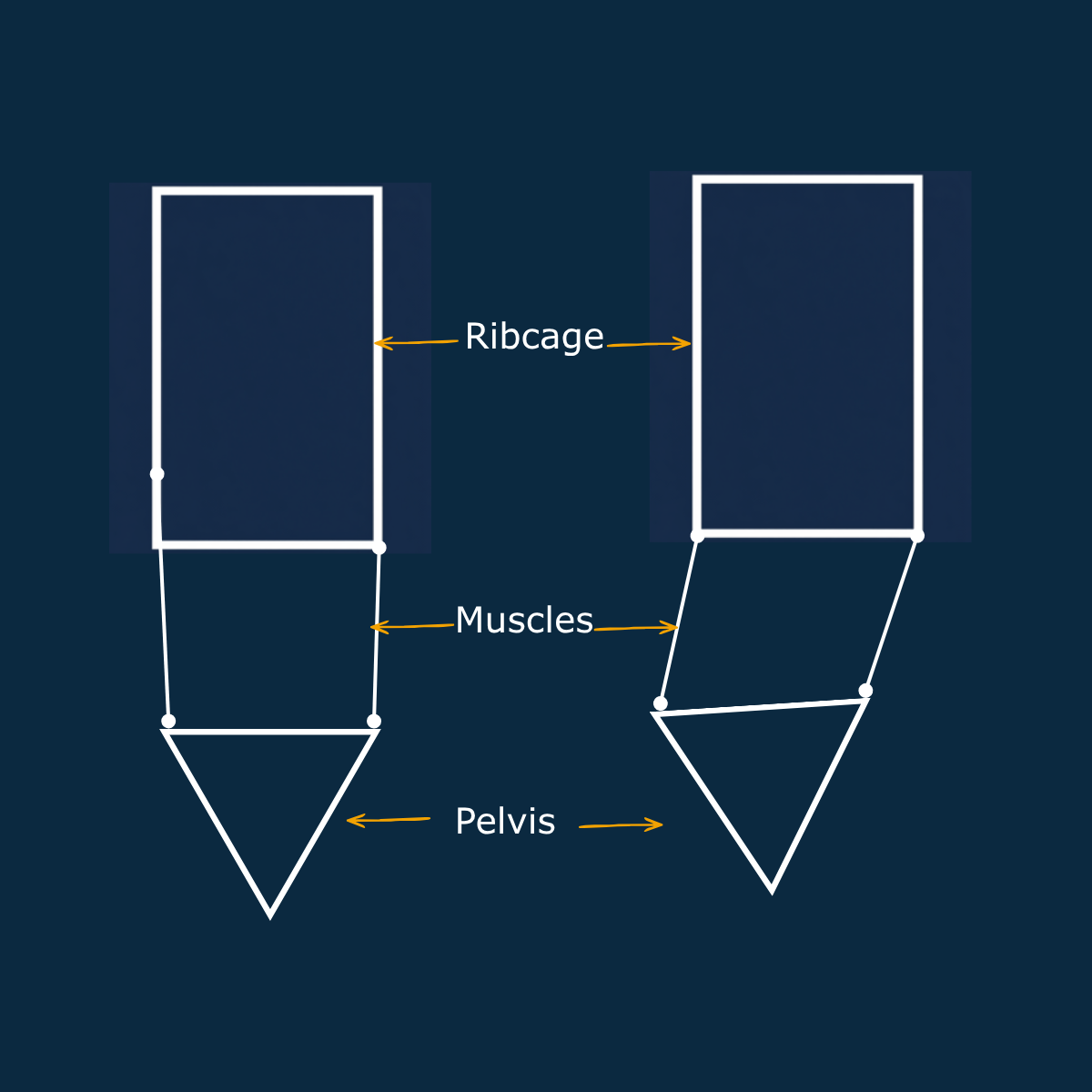
Left side - ribs and pelvis well stacked. Right side - poor stacking leading to changes in muscle length/tension
On the left you can see the stack and how the muscles attaching the ribcage and the pelvis to each other are nicely balanced.
But what’s this on the right?
The pelvis has shifted position.
The muscles are dragged into new positions.
No doubt the owner of this body will be feeling rather tight on one side. A bit clunky on the other.
In time their back and hips will likely feel rather niggly.
With this example there is just one muscle on each side. In reality you have at least 6 muscle groups running from the ribcage to the pelvis.
And it doesn’t stop at the pelvis.
Because your legs attach to the pelvis, changes in pelvic position affect how the hips and glutes function too.
The same thing happens higher up with the ribcage and shoulders.
(This is a long-winded way of saying your body is one connected mess of moving parts.)
You can look at a muscle in isolation (which is what usually happens) and say I really need to strengthen my glutes or rotator cuff.
Or feel you have to stretch your hips or pecs.
But you’ll likely be spinning your wheels until the relationship between the pelvis and ribcage is improved.
What Happened To Me?
Get your tissues ready because here comes my boo-hoo story.
Nearly all of my 30’s was spent with frustrating pains that derailed my training.
This isn’t the story of a major injury and a battle against the odds.
We’re talking about forearm tightness (keep the jokes clean please).
A shoulder that went clunk trying to show off on the monkey bars to my daughter.
Or leg pains that stopped me from running.
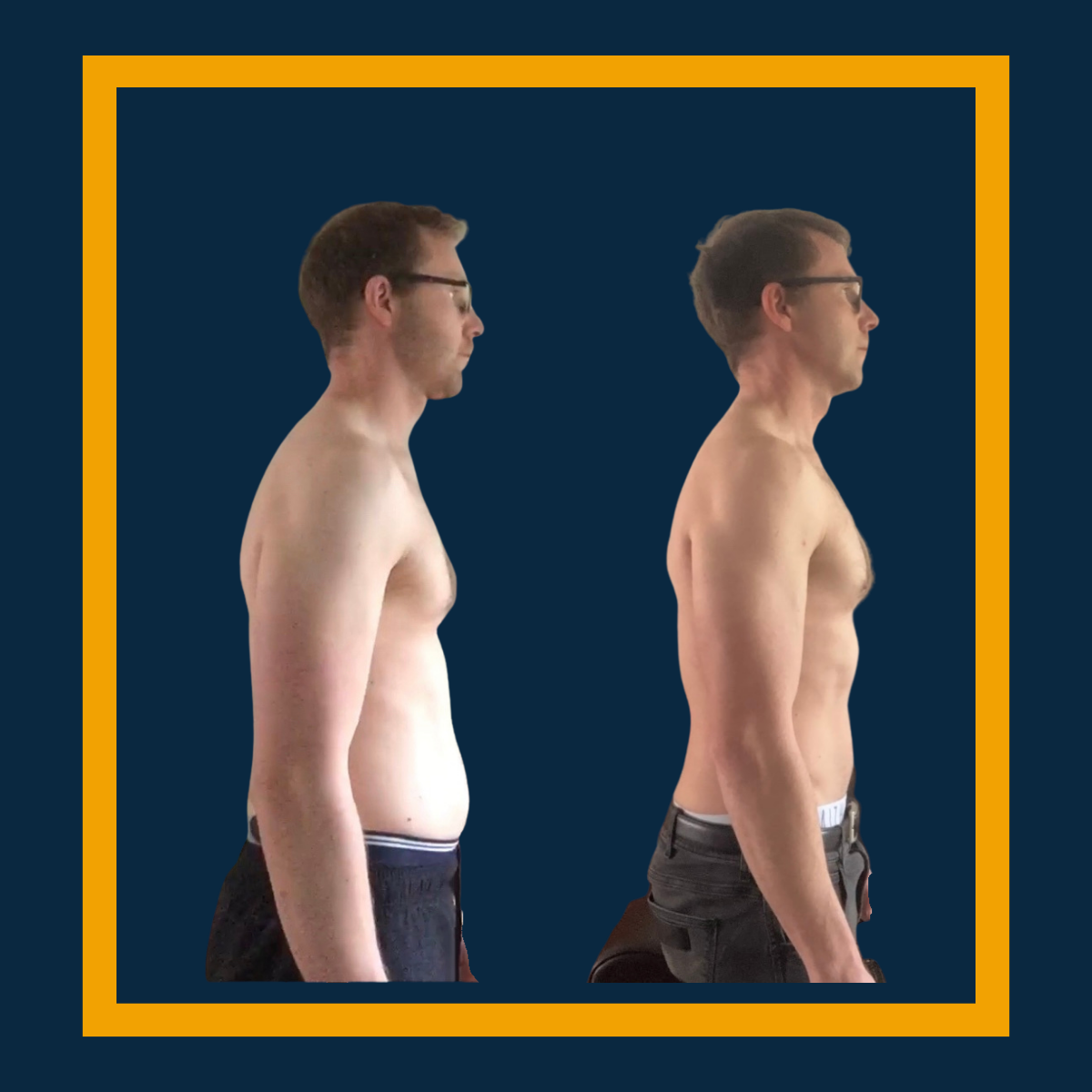
Be still your beating hearts, this me.
On the left I’m trying (again) to get myself back together.
The right is a couple of months later.
Here’s what I want you to see.
In the image on the left you can see far more of my back.
That’s because my pelvis is being pushed forwards relative to my ribcage.
Notice the little belly/paunch on the left?
At the time I thought my abs were weak.
In reality, my ribcage and pelvis position were creating pressure that pushed my stomach forwards.
This created pressure which pushed my stomach out.
A bit like how squeezing toothpaste in a tube affects the tubes shape.
One other detail you can see is my pant line (apologies for making you look at my pants, they were clean…honest).
You can see how there is a greater downward slope on the pant line in the left image compared to the right.
This can be a big clue of a forward tilt to the pelvis…aka anterior pelvic tilt.
A tilt like this isn’t necessarily a bad thing.
In fact many, many active people will have a tilt like this.
But in my case is was far too excessive.
Can Your Hips Lie?
For years I had known my hips were extremely immobile.
I used to go to kick boxing classes and wonder why everyone else could kick high, whilst anything above the ankle was safe from me.
I stretched those suckers.
Foam rolled.
Did endless mobility drills and they never changed.
I would squat, deadlift and lunge.
But my legs always felt unstable.
It wasn’t until I gave myself the ability to stack.
And focused on maintaining that stack during my lifts, rather than on how much weight I was moving that I started to progress.
Tech Neck and Rounded Shoulders
Let’s shift the action upstairs and take a look at some rounded shoulders.
With a peak at some forward head posture aka tech neck.
(I only heard the phrase “tech neck’ last month and I’ve been aching to use it).
Usually the shoulders are blamed on tight pec muscles, dragging the shoulders forwards.
You’d be told that the cause of this is too much bench pressing.
Or.
Slumping over a laptop or phone.
(Ha, I saw you sit up there).
The neck posture would be blamed on muscles connecting the skull to collar bones (such as sternocleidomastoid…try saying that after a few pints).
The solution would often involve stretching the pecs out and strengthening the pulling muscles on the back to hold things back.
But what if we’ve been missing something?
In both cases, the front of the ribcage has become compressed.
The ribs lose space and the chest effectively collapses forwards.
You can try it now.
If you slump over, does your head stay in the same place?
It moves forward a la tech neck.
While the ribcage is in this position the muscles on the back are lengthened.
They can’t contract fully and therefore appear to be weak.
To improve this, we need the front of the ribcage to expand again instead of staying permanently compressed.
Let’s Wrap This Up
It’s easy to assume that the solution to any weakness is to hit that area harder.
After all that’s the only solution we’ve ever been given.
But muscles can’t work properly when the joints around them leave them stuck in bad positions.
If a joint has become overly squashed or stretched, then the muscles around that joint will struggle to do their job and adapt…no matter how hard you push them.
(To find out if you’re really not pushing hard enough take a look at “Why You’re Not Seeing Results in the Gym”).
A great first step to improving function is to learn how to stack the ribcage over the pelvis.
This is one of the first things I teach clients who constantly feel tight, clunky or niggly.
(A great way to start learning this is shown in “How To Get Fit in Your 40’s”).
The goal of good movement isn’t to walk around like you’ve been at a Victorian finishing school.
But to allow your body to move from one position to another, without the need of inadvertent grunts or oofs.
To be able to hammer a morning of work at the desk and still be able to be athletic at lunch time.
This idea has helped me to restore trust in my own body so I know first hand how valuable it is.
Because feeling strong isn’t just about muscle.
It’s about trusting your body again.
If you’re over 40 and want cutting edge ways to build strength and get out of pain, you might rather like jmy fast growing newsletter and get them straight to your inbox for free. Click here to join.